Posting in a grammatically accurate manner
1 Comments Published by ginny on Wednesday, April 4, 2007 at 2:04 PM.
So I'm still thinking about the cat macros, or, as the site I linked to calls them, meme cats. In the theory class I'm taking, we just had a short discussion about mimesis and literary criticism. In lit crit the idea of mimesis or mimeticism is generally applied (with scorn, over the past 30 years or so) to the idea that a work will be somehow mimetic of life; that it will in some way succeed in reproducing something about how life is. Many armchair deconstructionists have applied this idea to mean that naive mimeticists believe that art can -- or strives to -- actually "represent" or "reflect" life without changing it; but since it's art, that can't be true. (Exciting point about critiques of this idea: what, you think there's some real, overarching Truth that art, as deception, does not capture? Come on! We all know that's not the way things work!)
 Anyway, though, in internet world, that's not precisely how mimesis is applied. On the internet, mimesis shows up through the idea of the "meme," a usage that is, as far as I can tell, taken from the Richard Dawkins-style idea of a "meme" as a unit of cultural-social thought-existence that is capable of "breeding" (or self-replicating with a difference). Dawkins uses the idea for his usual religion-bashing (a project I don't participate in), much like armchair deconstructionists bash the idea of mimesis -- as if to say "fools, don't you realize your cultural idea [religion] isn't a TRUTH, it's only a meme? It spreads because that's what memes do!" I think, honestly, this line of thought misses the point -- people may talk about truth, but spiritual or felt truth (the kind of truth required of religion) is quite different from the kind of empirical truth scientists seek. In other words: though empiricism has been quite a hearty meme in western thought for the past three hundred years or so, it also is a meme, and thus not some kind of originary given.
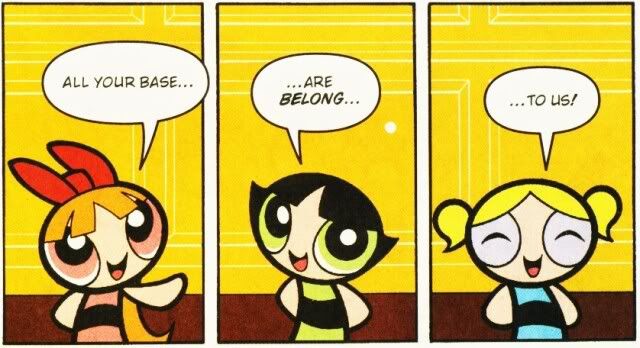 But on the internet, that fetishizing of the originary or the "true" isn't even at issue. The internet celebrates memes for their memeness. The point of a meme is that you neither know where it started (exactly) nor, crucially, why it started. Why did "All your Base are belong to us" become part of the internet zeitgeist so suddenly and completely? Why did it spawn years of responses using the same mimetic elements (certain reversed syntax "keys" or cues; a particular type of nonsensical animated jump-cut; even perhaps a particular use of techno music)? No one knows, and no one needs to know in order to enjoy it. The pleasure of participating in a meme -- which can involve replicating (iterating, reposting) it; evolving it (sequencing, responding); or simply viewing it (a combination of the two, since the meme will interact with other, similar things you know about) -- is precisely in its un-originariness. "All your Base" is pleasurable partly because it is everywhere for very little reason. (I mean, the grammatical errors are funny, but that's not what makes the whole thing funny. There are lots of grammatical errors around, and most of the don't become memes.)
And here's where I finally get back to the cat macros or cat memes. Because they strike me as a really astounding use of both mimesis and pleasure. The best cat macros are ones that get used and reused, combined and recombined, both from the picture and the text. There are an actually really small set of pictures and textual ideas that get combined in different ways over and over again to produce the peculiar pleasure of the cat macro. For example:
 Longcat
Happycat
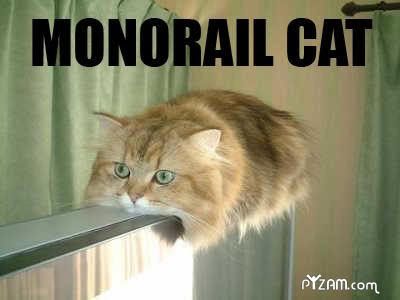
Monorail cat
Gigantic fat cat (there are two of these, the one being held by the red-haired girl and the gigantic white one on its back)
Ceiling cat
There are others, of course, but the point is that there are particular cats that recur, and that have a certain idea attached to them – a successful macro of Monorail cat should always have reference to the cat's status as Monorail cat. And then there are the text/ideas that go with the cats -- those are replicable and iterative too! For instance:
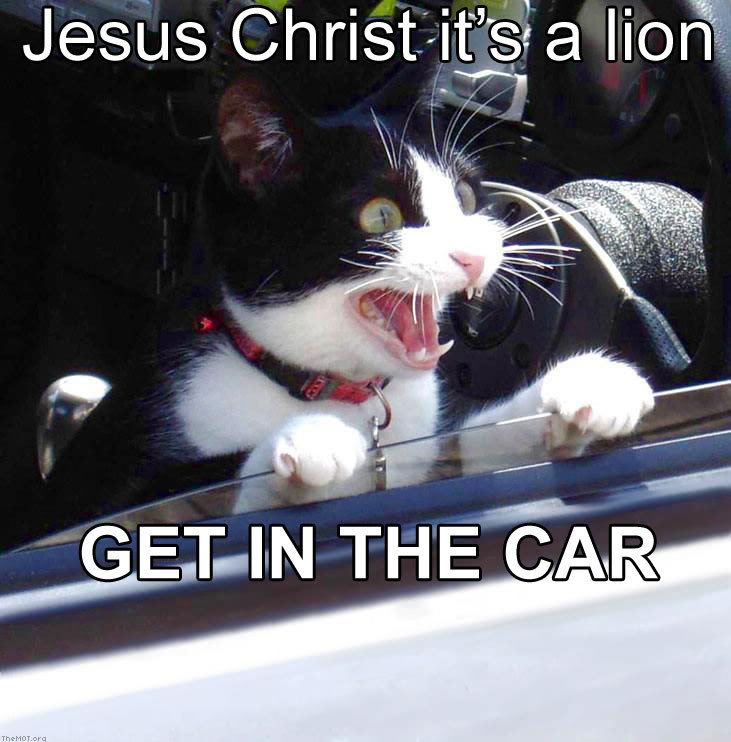
Again, there are a bunch more – and, it should be noted, almost all of these bear reference in some ways to an even bigger meme of L33T parody. The use of all caps, particular misspellings/ leet spellings or words (internets, n00b, pwnd, omfg, etc.), and a predominance of hacker or leet themes, such as cats repairing or destroying computers; hostile "I kill you" cats; cats referring to video games; even perhaps the idea of surveillance, which fits right in with the idea of the "leet" being people who believe they have the right to surveil and curtail others' internet activates – all are semi-consciously used both in support of and in parody of an outdated form of internet culture. That is: the biggest meme of all is "net culture."
And thus we're back to the idea of mimesis that actually creates. In cat macros, I think, you can see in very simple form culture actually creating itself. Out of a small number of elements, endlessly and self-referentially combined, one begins to piece together an entire culture. It has history, aims and goals, containment or censorship -- just like any other culture, only smaller and more readable at this stage. It's awesome.
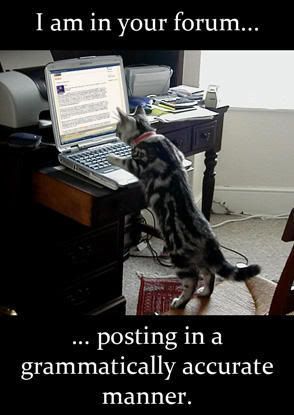 And, of course, I myself am pretty much a newcomer to all this – like the cultural anthropologist, I'm guilty of looking from the outside, to a large extent, and that means that I'm of course bringing my own ideology with me and using it to re-construct the culture I'm viewing. One terrific thing about the internet, though, is that everyone is outside to some extent or other (this is one thing that l33t seeks, unsuccessfully, to regulate, and a reason why it is [perhaps from the beginning] always-already parody). So. In conclusion. I really enjoy cat macros. But because I am a terrible nerd, I can't enjoy them without thinking about why I enjoy them and what that has to say about the production of culture. And I also enjoy that.
Anyway, though, in internet world, that's not precisely how mimesis is applied. On the internet, mimesis shows up through the idea of the "meme," a usage that is, as far as I can tell, taken from the Richard Dawkins-style idea of a "meme" as a unit of cultural-social thought-existence that is capable of "breeding" (or self-replicating with a difference). Dawkins uses the idea for his usual religion-bashing (a project I don't participate in), much like armchair deconstructionists bash the idea of mimesis -- as if to say "fools, don't you realize your cultural idea [religion] isn't a TRUTH, it's only a meme? It spreads because that's what memes do!" I think, honestly, this line of thought misses the point -- people may talk about truth, but spiritual or felt truth (the kind of truth required of religion) is quite different from the kind of empirical truth scientists seek. In other words: though empiricism has been quite a hearty meme in western thought for the past three hundred years or so, it also is a meme, and thus not some kind of originary given.But on the internet, that fetishizing of the originary or the "true" isn't even at issue. The internet celebrates memes for their memeness. The point of a meme is that you neither know where it started (exactly) nor, crucially, why it started. Why did "All your Base are belong to us" become part of the internet zeitgeist so suddenly and completely? Why did it spawn years of responses using the same mimetic elements (certain reversed syntax "keys" or cues; a particular type of nonsensical animated jump-cut; even perhaps a particular use of techno music)? No one knows, and no one needs to know in order to enjoy it. The pleasure of participating in a meme -- which can involve replicating (iterating, reposting) it; evolving it (sequencing, responding); or simply viewing it (a combination of the two, since the meme will interact with other, similar things you know about) -- is precisely in its un-originariness. "All your Base" is pleasurable partly because it is everywhere for very little reason. (I mean, the grammatical errors are funny, but that's not what makes the whole thing funny. There are lots of grammatical errors around, and most of the don't become memes.)And here's where I finally get back to the cat macros or cat memes. Because they strike me as a really astounding use of both mimesis and pleasure. The best cat macros are ones that get used and reused, combined and recombined, both from the picture and the text. There are an actually really small set of pictures and textual ideas that get combined in different ways over and over again to produce the peculiar pleasure of the cat macro. For example:
LongcatHappycat
Monorail cat
Gigantic fat cat (there are two of these, the one being held by the red-haired girl and the gigantic white one on its back)
Ceiling cat
There are others, of course, but the point is that there are particular cats that recur, and that have a certain idea attached to them – a successful macro of Monorail cat should always have reference to the cat's status as Monorail cat. And then there are the text/ideas that go with the cats -- those are replicable and iterative too! For instance:
- "Ceiling cat is watching you masturbate" or "I see what u do thar" – both indications of a sort of "surveillance by cat" sub-meme
- Cookies: "I made u a cookie," "you eated my cookie," "whar are cookies," "tiem for cookies nau plz"
- "Tiem for…nau plz": can apply to anything the cat is being configured as wanting, such as food (gushy foodz), play, cookies, world domination, whatever
- "Invisible" object: the master-trope here is "invisible bike," but you can posit all sorts of other invisible objects, which always carry reference back to "invisible bike"
Again, there are a bunch more – and, it should be noted, almost all of these bear reference in some ways to an even bigger meme of L33T parody. The use of all caps, particular misspellings/ leet spellings or words (internets, n00b, pwnd, omfg, etc.), and a predominance of hacker or leet themes, such as cats repairing or destroying computers; hostile "I kill you" cats; cats referring to video games; even perhaps the idea of surveillance, which fits right in with the idea of the "leet" being people who believe they have the right to surveil and curtail others' internet activates – all are semi-consciously used both in support of and in parody of an outdated form of internet culture. That is: the biggest meme of all is "net culture."
And thus we're back to the idea of mimesis that actually creates. In cat macros, I think, you can see in very simple form culture actually creating itself. Out of a small number of elements, endlessly and self-referentially combined, one begins to piece together an entire culture. It has history, aims and goals, containment or censorship -- just like any other culture, only smaller and more readable at this stage. It's awesome.
And, of course, I myself am pretty much a newcomer to all this – like the cultural anthropologist, I'm guilty of looking from the outside, to a large extent, and that means that I'm of course bringing my own ideology with me and using it to re-construct the culture I'm viewing. One terrific thing about the internet, though, is that everyone is outside to some extent or other (this is one thing that l33t seeks, unsuccessfully, to regulate, and a reason why it is [perhaps from the beginning] always-already parody). So. In conclusion. I really enjoy cat macros. But because I am a terrible nerd, I can't enjoy them without thinking about why I enjoy them and what that has to say about the production of culture. And I also enjoy that. Labels: language, nerd power, spirit of the age, web


though empiricism has been quite a hearty meme in western thought for the past three hundred years or so, it also is a meme, and thus not some kind of originary given
This exact thought is, like, the most terrifying thing a science person ever realizes. The 'originary given' part, I mean. No one in science talks about it!
Also, can I just say that it's really annoying that science has to use art (words) as a medium to convey ideas? Science types *want* to be naive memeticists, I guess, but words, as art, won't let us. Variables are more exact than words, and it tears me apart!